Tuscaloosa Demolition Pros: The Tuscaloosa Demolition Permit, Step by Step
Tuscaloosa Demolition Pros hears the same question before almost every Tuscaloosa teardown: what does the City need before a machine can touch the house? The permit itself is cheap. The steps around it, from the sewer cap to the debris deadline, are where a job stalls, so this guide walks them in the order they happen.
Who Needs a Tuscaloosa Demolition Permit
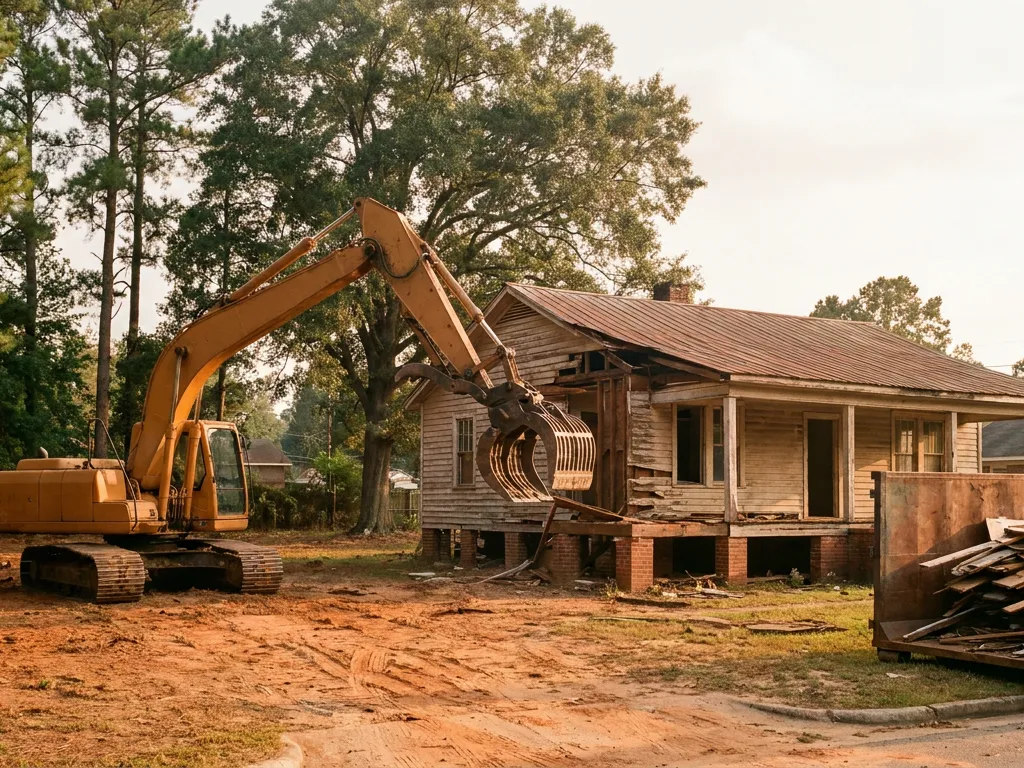
The City's rule is plain: "Permits are required for all new construction, demolitions, remodel, and alterations." That covers a house, a garage or a commercial building inside city limits. The City's building codes also reach into its police jurisdiction (Sec. 6-50), which state law sets at three miles beyond the limits for a city of 6,000 or more (Code of Alabama 11-40-10). Whether a given county address falls inside it is a question for the City, not a guess.
Tearing down to rebuild? The City asks for two permits: a Demolition permit and a separate New Construction permit.
Applying for the City Permit, in Order
- Cap the sewer lateral first. The City will not issue a demolition permit until its director of infrastructure signs off on a capped sewer lateral inside the City easement, marked with a locator plate (Sec. 6-12(d)). Sewer work takes its own plumbing permit.
- Fill in the online application. Residential and commercial jobs each have an online form, and both want the number of a City business license. On the residential form, a project over $10,000 needs an Alabama Home Builders license number; commercial work of $100,000 or more needs a State General Contractor's license.
- Pay the fee. Residential demolition permits cost $21.00 and commercial ones $26.00 (Sec. 6-115(c)), with water and sewer fees possible on top.
- Wait for review. By the City's own account, a residential permit usually clears review in 24 to 48 hours.
- Start only after it is issued. Sec. 6-116(b)(8) adds a 100% late fee to work begun ahead of the permit, so jumping the gun means paying twice.
Would rather not juggle the sewer cap, the permit and the locate yourself? Call, and the contractor who quotes your job explains who handles each step.
Call (205) 590-9261Dumpsters, Debris and Leftover Concrete Under the City Code
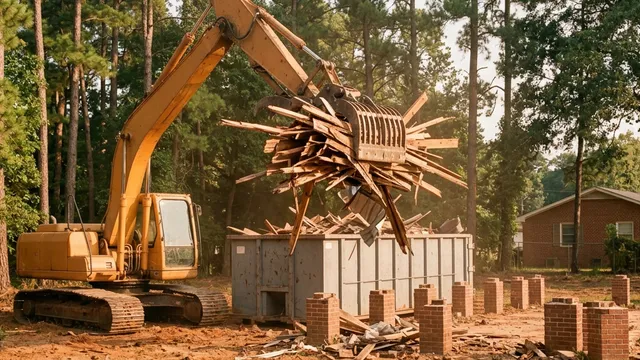
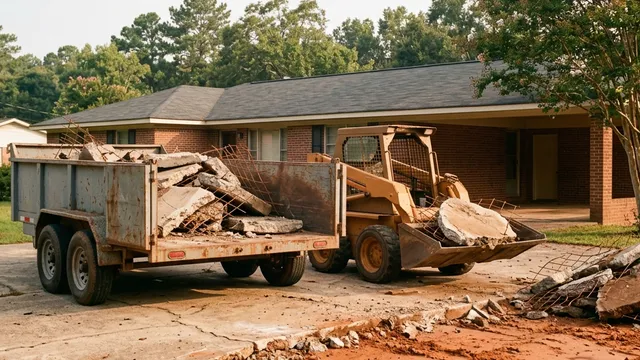
Three code sections govern what happens once the walls are down. Sec. 6-12(e) allows 30 days to clear every bit of demolition debris off the site. Sec. 16-101 puts the haul on whoever does the demolishing, with the debris going to a lawful disposal site, and parking a roll-off on the street takes a right-of-way permit, applied for on the City's Off-Site Dumpster Permit Application. Under Sec. 6-51(d), once no main building stands, any leftover slab, foundation, sidewalk or driveway has to go and the ground has to be put back to a natural state.
Pulling out a driveway approach in the right-of-way is its own step: Sec. 21-219 requires a land development permit for it.
Historic Districts and the Lake Watersheds
The code names 23 historic districts; Druid Hill, Pinehurst Drive, The Downs and Eighth Street are four of them. Inside one, a teardown first needs the Historic Preservation Commission to approve a Certificate of Appropriateness (Sec. 20-15.29). The Commission wants to see what will replace the house, and proof the owner can finish that replacement, before it will hear the case. If it has not ruled 60 days after a complete application, the application counts as approved, and a case can be tabled twice at most. The City puts a sign on the property and sends public notice, and the building permit cannot issue until the Commission has been told in writing (Sec. 6-116(b)(11)). Letting a historic house fall apart, demolition by neglect, also needs a certificate.
Near the water, the City adds steps: a Land Development Permit for work beside Lake Tuscaloosa, and a Site Stabilization Plan for any site draining to Lake Tuscaloosa, Harris Lake or Lake Nicol.
ADEM Form 496 and the Alabama 811 Window
ADEM expects notice 10 days ahead of tearing down a regulated structure (the federal rule counts 10 working days), submitted as Form 496 in AEPACS, the agency's online portal. A typical house is often outside that rule. In ADEM's words, "Privately owned residential buildings of 4 or less units that remain residential property are exempt from asbestos regulations, but they must comply with State Solid Waste Regulations." The agency also cautions that the exemption leaves homeowners exposed, and it does not cover a house that is part of a larger project.
Alabama 811 is not optional. Code of Alabama 37-15-4(b) sets the timing: file the locate request at least two working days ahead of the teardown, and not more than 30 calendar days ahead. A demolition request then holds for 30 working days. Calling costs nothing, and each utility marks its own lines.
How Northport and the Small Towns Differ From Tuscaloosa
Northport writes its own permits. Its Zoning Ordinance section 12.06.01 bars any construction activity, "including ... demolition of any structure", until the Building Official issues a building permit. There is no separate demolition form: the combined building permit application has a "Raze" checkbox, and a permit dies if no work starts in six months. Northport also runs its own electric, gas and water service, so disconnects there go through the City of Northport.
Vance has a Chief Building Inspector and online permitting. In Moundville, the town hall sets the fee. In Coker, Coaling and Brookwood, no permit page could be found, so ask the town hall before any work. For unincorporated places such as Holt and Cottondale, there is no county building-permit page to point to; the County does publish a Flood Plain Permit Application.
The permit is the smallest cost in a house demolition, and the steps around it are what set the start date. If the lot is across the river, start with the Northport page, since that city's office, not Tuscaloosa's, writes the permit.
Want a number for your own lot? (205) 590-9261
Frequently Asked Questions
Permit Questions From Tuscaloosa Owners
Do I need a permit to tear down my own house in Tuscaloosa?
Yes. Every demolition inside the City needs one, and the City's building codes also reach its police jurisdiction. Before the permit is issued, the sewer lateral has to be capped and fitted with a locator plate.
How much is a demolition permit in the City of Tuscaloosa?
Sec. 6-115(c) sets the minimum at $21.00 for a house and $26.00 for a commercial building. Water and sewer charges can be added, and work started ahead of the permit pays a 100% late fee.
Does ADEM have to be notified before a house is demolished?
For a regulated structure, yes: a 10-day notice on Form 496 through AEPACS. A private home of four units or fewer that stays residential sits outside the asbestos rules, though ADEM warns that this leaves owners carrying the risk.
How far ahead do I call Alabama 811 for a demolition?
State law sets a window of at least two working days and no more than 30 calendar days before the demolition begins. One request covers 30 working days of work, there is no charge, and the utilities do the marking.
Is the Northport demolition permit the same as Tuscaloosa's?
No. Northport issues its own building permit for demolition, using the combined application with the Raze box checked. That permit lapses if work does not begin within six months, and utilities inside Northport are disconnected through the City of Northport.