After the Teardown
Tuscaloosa Demolition Pros: Lot Clearing After Demolition in Tuscaloosa, AL
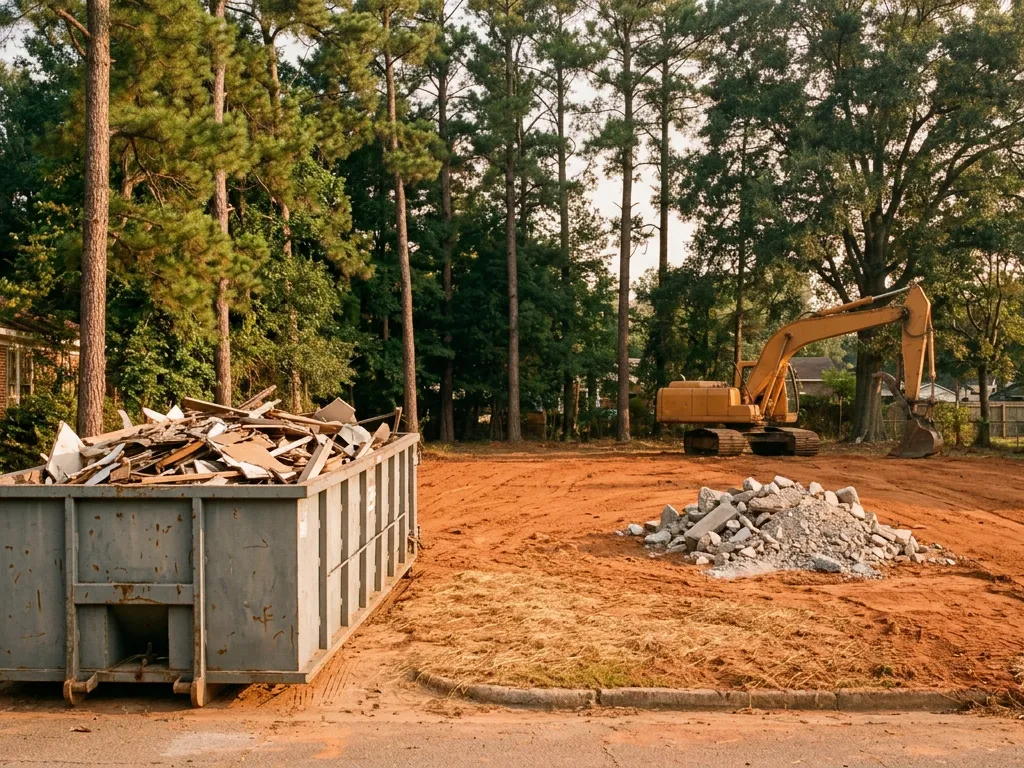
The last of the slab, the stumps and the brush taken off, the ground graded to drain, and the lot left ready to sell, build on or seed.
- Tuscaloosa, Northport and towns within 20 miles
- Licensed, insured local contractors
- Houses, mobile homes, garages and pools
- Written price before work starts
- Debris hauled and the lot graded
Tuscaloosa Demolition Pros puts Tuscaloosa owners in touch with local contractors who finish the job after a building comes down: the leftover slab and footings, overgrown brush, stumps, an old septic tank, and the grading that turns a scraped lot into usable ground. This page covers lot clearing after demolition in Tuscaloosa and the surrounding towns, what clearing costs by lot size, what the City expects once a house is gone, and the soil and water rules that shape the final grade.
Clearing a quarter-acre lot right after the teardown runs $800 to $3,000 in HomeGuide's guide; leave it to grow back for a few seasons and each volunteer tree that takes hold can cost $400 to $1,200 to remove.
What Lot Clearing After Demolition Covers in Tuscaloosa
A demolition crew takes the building away, but the lot is not always finished. There may be a slab or pier footings still in the ground, a driveway and walk, a fence line full of brush, trees that grew against the house, or a septic tank in the yard. Tuscaloosa's property maintenance code, Sec. 6-51(d), calls for abandoned slabs, foundations, sidewalks and driveways to be removed where no primary structure remains, and the surface returned to a natural state. Lot clearing is the step that gets there, and the contractor who quotes your job walks the whole parcel, not just the old footprint.
Lot Clearing Costs by Lot Size
$800 to $3,000
Clearing a quarter-acre lot, from HomeGuide's 2026 guide, How Much Does It Cost to Clear Land? An eighth of an acre runs $600 to $2,000 and a full acre $1,200 to $8,000; trees and stumps are priced on top.
HomeGuide's 2026 land clearing guide puts a quarter-acre lot at $800 to $3,000, an eighth of an acre at $600 to $2,000, and a full acre at $1,200 to $8,000. Trees are extra at $400 to $1,200 each, and stump grinding runs $100 to $400 a stump. Grading is priced at $0.50 to $5.00 per square foot and backfill at $3 to $6 per cubic yard. Density of brush, the number of large trees, slope and how much fill a basement or pool hole needs all move the price. Ask whether seed, straw and silt fence are included.
Old Septic Tanks, Footings and Fill on a Cleared Lot
A lot outside the sewer system may have a septic tank. Alabama's rule for a discontinued tank, Administrative Code 420-3-1-.24, is that it is pumped out by an AOWB-licensed pumper, then removed or left in place filled with sand or soil, and a removed tank's hole is filled the same way. HomeGuide puts pumping at $300 to $700 and abandonment permits at $100 to $250 per leach field; ask the county health department what applies. Footings and buried concrete are dug out with an excavator, holes are filled and compacted in lifts, and topsoil goes back over the red clay.
Soils, Floodplains and Lake Watersheds Around Tuscaloosa
The largest soil units in the Tuscaloosa County survey are the Montevallo-Nauvoo and Smithdale-Luverne associations, and about 9.5% of mapped acres fall in units USDA calls frequently or occasionally flooded. The City requires a Site Stabilization Plan for work in the watersheds of Lake Tuscaloosa, Harris Lake or Lake Nicol, and a Land Development Permit next to Lake Tuscaloosa; it names floodplains along the Black Warrior River, Cribbs Mill Creek and Cottondale Creek, among others. Bare clay washes fast, so silt fence and seed belong in the plan.
For lot clearing near Brookwood, a coal-mining town where USDA maps disturbed, mine-spoil type Palmerdale very shaly loam, no permit page was found: ask city hall before grading.
Signs a Lot Still Needs Clearing After Demolition
- Pieces of the old slab or brick piers still poke out of the ground
- Brush and saplings are growing up through the old footprint
- There is a low spot where the house or a pool used to be
- Red clay washes into the street after every hard rain
- An old septic lid or cleanout is still in the yard
- A buyer or builder asked for a clean, graded lot
Finish the Lot After Demolition in Tuscaloosa
Tell us the lot size, what is still on it and what comes next, and a local contractor calls back with a written clearing and grading price.
Call (205) 590-9261Lot Clearing Available In
Frequently Asked Questions
Lot Clearing Questions From Tuscaloosa Owners
How much does lot clearing cost after a house is demolished in Tuscaloosa?
HomeGuide's 2026 land clearing guide puts a quarter-acre lot at $800 to $3,000, an eighth of an acre at $600 to $2,000 and a full acre at $1,200 to $8,000. Trees, stumps, leftover concrete and fill are the items that move the price.
What are the signs a demolished lot was not properly cleared?
Chunks of slab or piers still in the ground, a low spot that holds water where the house stood, soft fill that settles underfoot, brush returning, and red clay washing off the lot. Each one means grading or fill work was left unfinished.
Does the City of Tuscaloosa require the slab to be removed?
Where no primary structure remains, Tuscaloosa Code Sec. 6-51(d) calls for abandoned slabs, foundations, sidewalks and driveways to be removed and the surface returned to a natural state. Ask the Building and Inspection Division at 205-248-5110 how that applies to your lot.
What happens to an old septic tank when the lot is cleared?
Under Alabama Administrative Code 420-3-1-.24, a discontinued tank is pumped by an AOWB-licensed pumper, then removed or filled in place with sand or soil. HomeGuide puts pumping at $300 to $700. Ask the county health department what permit applies.
Do I need a site stabilization plan to grade my lot?
Inside Tuscaloosa, a Site Stabilization Plan is required for projects in the watersheds of Lake Tuscaloosa, Harris Lake or Lake Nicol, and a Land Development Permit for projects next to Lake Tuscaloosa. Elsewhere, silt fence and seed still help keep clay out of the street.